Tuesday, May 26, 2009

Traditions & Customs


Saudi Arabia is known for its hospitality and guest care. An ancient custom that is still performed in the Saudi culture is that when a guest is invited into the household that they are offered a cup of coffee and date palms ("Customs & Traditions"). Also, when a guest is invited into the household for a meal then they should leave some food on their plate, this is a sign showing that they were satisfied by the mean ("Customs & Traditions").
Traditional garmets are a must for the Saudi to wear. The key thought to keep in mind when dressing is "conceal rather than reveal." Men are to wear a thobe, which is the traditional dress that expresses equality. Women wear an abayah, which is a black cloak. In public that is all you will ever see a woman wear, however beneath it they do wear fashionable clothing and are very proud of their appearance. ("What to Wear in Saudi Arabia").
Customs and traditions regarding the Islamic religion are based on the tenets in the Quran. One big tradition in this culture occurs during the holy month of Ramadan. During this time Muslims are to fast from dawn to dusk, which includes no eating, drinking, or smoking, and they are not allowed to work more than 6 hours in one day. After the sun sets each night durning Ramadan families and friends come together to celebrate the end of the fasting day where these festivities continue late into the night ("Saudi Society & Culture").


Sources:
"What to Wear in Saudi Arabia." Traditional Saudi Arabia Clothing. http://www.users.globalnet.co.uk/~chern/saudi/clothes.html. Accessed May 30, 2009.
"Saudi Society & Culture." Language, Culture, Customs, & Etiquette. http://www.kwintessential.co.uk/resources/global-etiquette/saudi-arabia-country-profile.html. Accessed May 26, 2009.

The Role of Islam in Saudi Arabia


Watch this video: Islam: spread of the practice of Islam
Video from "History of Arabia." Encyclopedia Britannica. http://www.britannica.com/EBchecked/topic/31568/history-of-Arabia/45985/The-Umayyad-and-Abbasid-periods. Accessed May 24 2009.


The role of Islam is the largest faith in Saudi Arabia. The Islamic faith has a rocognized symbol of a cresent moon and a star. This faith provides the framework of religion for the Muslim way of life in Saudi Arabia ("Islamic Faith"). The framework consists of The Five Pillars of Islam:

FIRST PILLAR; Shahada: "I witness that there is no God but God and Muhammad is the Messenger of God"

SECOND PILLAR; Salat: Pray 5 times a day

THIRD PILLAR; Sawm: Abstain each day in the Holy Month of Ramadan

FOURTH PILLAR; Zakat: Giving alms to the poor

FIFTH PILLAR; Hajj: The pilgrimage to Mecca/Makkah


Islam was born in Saudi Arabia around 610BC. It is practiced by all Saudis and governs their lives. Like Jesus brought the bible, Muhammad brought the last book called The Quran. This book is used for guidance ("Saudi Society & Culture").


Sources: "Islamic Faith." Islam in Saudi Arabia. http://www.toursaudiarabia.com/islam.html. Accessed May 24, 2009.
"SaudiSociety & Culture." Language, Culture, Customs, & Etiquette. http://www.kwintessential.co.uk/resources/global-etiquette/saudi-arabia-country-profile.html. Accessed May 24, 2009.

Thursday, May 21, 2009

Religion

Religious Ruling & Conflict
The official religion of Saudi Arabia is Islam. Saudi Arabia is an Islamic monarchy and has no legal protection for freedom of religions, therefore the country requires that all the citizens to be Muslim. Because of this, the government prohibts any practice that defers from the Muslim religion of Islam. A citizen is allowed to practice non-Muslim religion in private, however it is not always respected ("International Religious Freedom Report").
* Is usually classified as part of Shi'i Islam, but is best considered

an independent regligion.
Table from "Religions".


Sources:
"Religions." Saudi Arabia - Religion. http://looklex.com/e.o/saudi_arabia.religions.htm. (Accessed May 21st, 2009).
"International Religious Freedom Report." Saudi Arabia. http://www.state.gov/g/drl/rls/irf/2002/14012.htm. (Accessed May 21st, 2009).


Wednesday, May 20, 2009

The Old & The Present


Back in Time...

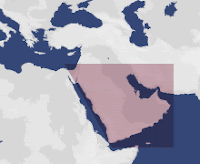
From 8000BC to 2000BC Saudi Arabia was a part of the Arabian Peninsula.

The highlighted region represents the Arabian Peninsula:


The highlighted region in detail:

Both images from: http://www.metmuseum.org/toah/ht/02/wap/map.htm

Languages

The current language spoken in Saudi Arabia is Arabic ("Saudi Arabia").


http://www.oman-stamps.com/images/arabic.gif

Man-Made Architectural Features of Saudi Arabia

Concrete and cement where not the founding ingredients in architecture in Saudi Arabia. They used limestone and coral due to its abundance in the area as well as palm trees and tree trunks to make pillars and roofs, all combined made the architeture an art in itself ("Architecture").


Both pictures from: http://www.kookynet.net/148.html

Other architectural features dating back to early century includes the layouts of homes. In most cases floor plans were very big and spacious.


Both pictures from: http://www.kookynet.net/148.html


Sources:

"Architecture". Asia Rooms. http://www.asiarooms.com/travel-guide/saudi-arabia/culture-of-saudi-arabia/architecture-of-saudi-arabia.html. (Accessed May 20th, 2009).

"Saudi Arabia". The World Fact Book. https://www.cia.gov/library/publications/the-world-factbook/geos/sa.html. (Accessed May 20th, 2009).

Tuesday, May 19, 2009

Stereotypes


Stereotypes of Saudi Arabia:

1. They must all wear Keiffiehs (a traditional headdress made of cloth that protects the head and face from the sun, heat, wind, and dust).

2. That all men either have a long beard and/or always carry an AK-47.
3. They are terrorists and are always threatening to blow something up.


http://media.nationalreview.com/post/?q=ZjE3NWI0MTAzYjVkNzhiMTI3OTUxMDJmN2U5M2E0ODQ=


Camel picture above from: http://gamesmuseum.uwaterloo.ca/Archives/Davies/camel.jpg

Geographics

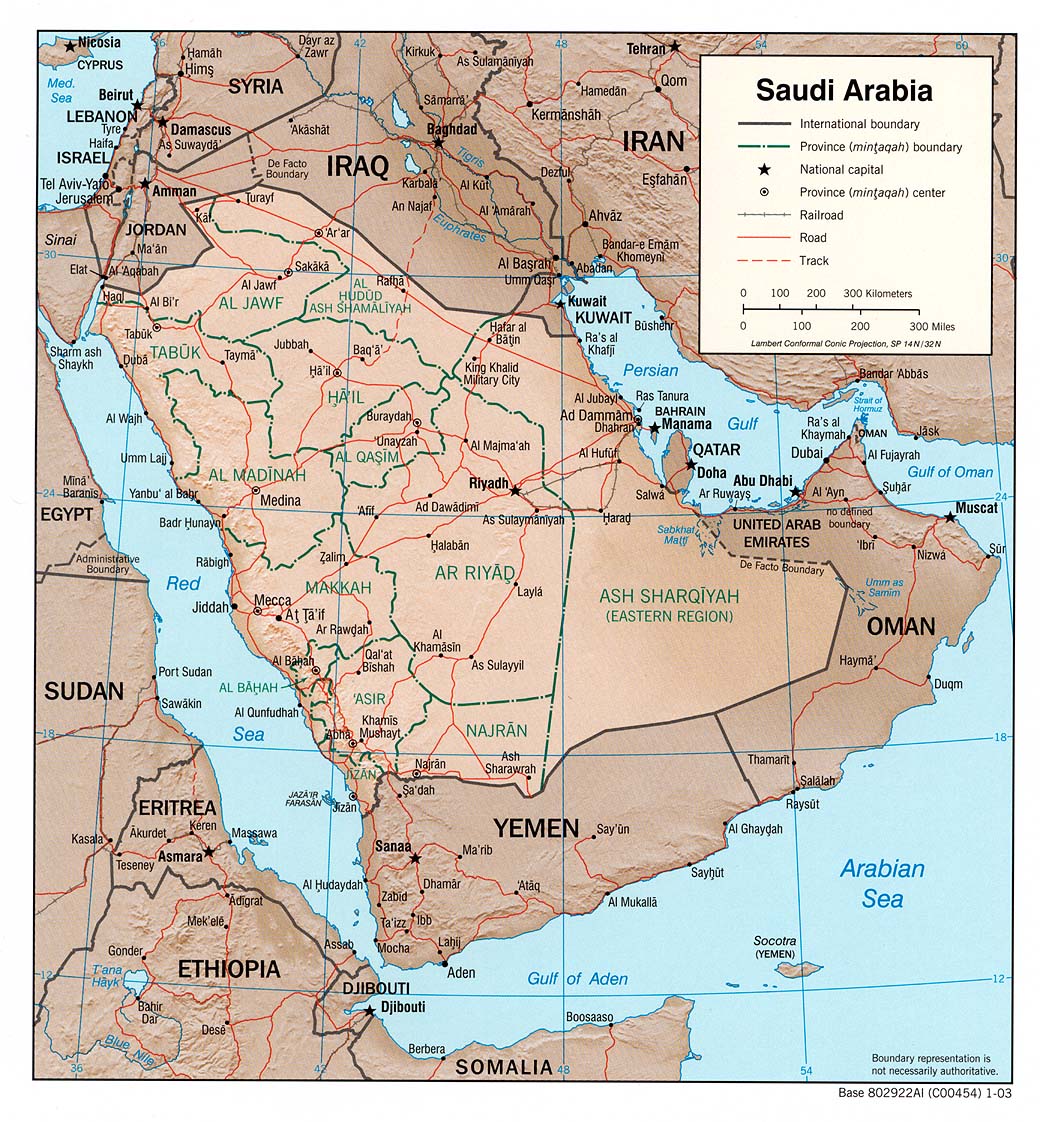
Saudi Arabia
http://www.lib.utexas.edu/maps/middle_east_and_asia/saudi_arabia_rel_2003.jpg


Five major geographical features:

1. Due to harsh, dry, and extreme temperatures the terrain is mostly uninhabited made up of sandy deserts where natural hazards of frequent dust and sand storms occur ("Saudi Arabia").

2. Extensive coastlines of 2,640km on the Persian Gulf and Red Sea provide great access to being able to ship through the Persian Gulf and Suez Canal ("Saudi Arabia").

3. Natural Resources of this country include: petroleum, natural gas, iron ore, gold, and copper ("Saudi Arabia").

4. The highest elevation is 133m at Jabal Sawda and the lowest elevation at 0m at the Persian Gulf ("Saudi Arabia").


5. The total land area is 1,960,582km (slightly more than 1/5 the size of the United States) with only 4,350 sq km of that land irrigated ("Saudi Arabia").

* Sources: "Saudi Arabia". Britannica Online. http://www.britannica.com/EBchecked/topic/525348/Saudi-Arabia. (Accessed May 18, 2009).


<-- Picture of sandy deserts


"RubĘż al-Khali," Encyclopedia Britannica, http://www.britannica.com/EBchecked/topic-art/652831/101411/The-Rub-al-Khali-a-desert-lying-mainly-in-southeastern.